
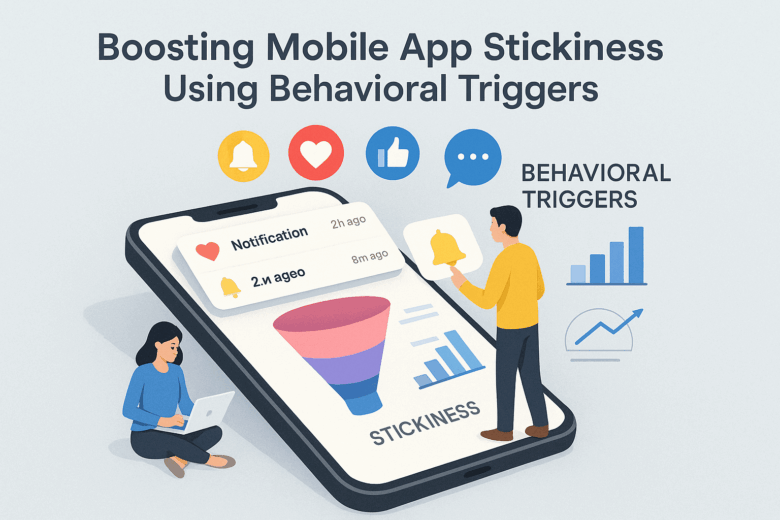
Every mobile app founder loves a spike in downloads. The real win, though, is when users keep coming back, explore more features and slowly build a habit around your product. That invisible pull which makes people open your app again and again is what we call stickiness.
In crowded app stores, stickiness is no longer a nice to have. It is the difference between a promising idea and a sustainable business. One of the most powerful ways to increase stickiness is by using behavioral triggers that nudge users at the right moment, in the right context and for the right reason.
Let us look at how you can use behavioral triggers in a thoughtful, product led way.
What Stickiness Really Means For Your App
Stickiness is not just about daily logins. It is about how naturally your app fits into a user’s routine. A sticky app is one that users:
- return to without heavy discounts or gimmicks
- rely on to solve a recurring problem
- recommend to people around them
You can measure it with metrics like retention curves, day 1 or day 7 return rates and the DAU to MAU ratio. When these numbers improve, it usually means your app is becoming part of a real habit, not just a one time experiment.
Behavioral triggers help here because they reduce friction and remind users of the value your app already offers. Instead of forcing behavior, they gently surface the right action at the right time.
The Psychology Behind Behavioral Triggers
A trigger is any cue that prompts a user to act. In behavior design, there are two broad types of triggers. Internal triggers are driven by emotions or states like boredom, stress or curiosity. External triggers come from outside the person, such as notifications, emails or in app prompts.
When an internal trigger meets your product at the right time, you get a very strong pull. Think of someone feeling anxious about expenses and opening a finance app to check spending. If your app understands that pattern and supports it, you are well on your way to creating a habit loop.
A simple habit loop has three parts. There is a cue, then a routine and finally a reward. Over time the brain starts to anticipate the reward as soon as the cue appears. Behavioral triggers are how you design those cues and routines inside your app, so that the reward feels natural and earned rather than manipulative.
Mapping The User Journey To Find Trigger Moments
Before you add any trigger, you need clarity about your user journey. Start from install and move step by step. Where do users drop off. Where do they get stuck. Where do engaged users behave differently from casual ones.
Common stages include onboarding, activation, discovery and habit. During onboarding you want to trigger simple actions that show value quickly. During activation you might prompt users to complete a key setup step that unlocks future benefits. Later, you can use triggers to re introduce underused features that match their behavior.
For example, imagine a productivity app that notices a user creating tasks but never using reminders. After a week of observation, the app could gently suggest enabling smart reminders for tasks that are overdue. This is a behavioral trigger rooted in actual usage, not guesswork.
The more you instrument your product with meaningful events, the better your triggers become. Every interaction is a data point about what users care about and when they are most open to a nudge.
Types Of Behavioral Triggers That Increase Stickiness
There are many ways to design behavioral triggers, but a few patterns show up again and again in successful apps.
Contextual triggers respond to where and when the user is. A fitness app that prompts a short workout in the evening after a sedentary day is using context. A finance app that notifies you right after a large transaction is doing the same.
Milestone triggers celebrate progress. When a language learner completes several sessions in a row, a small in app celebration combined with a suggestion for the next challenge can be very powerful. These triggers reinforce identity and make users feel that the app is on their side.
Value triggers surface timely benefits. For an ecommerce app this could be alerting a user when an item they viewed drops in price. For a SaaS tool it could be an in app hint that shows how to save time based on the user’s current workflow.
Social triggers tap into our need for connection. Letting users know when a teammate comments on their document, or when friends join a challenge, adds a layer of community on top of individual behavior. Used sparingly, such triggers can keep people emotionally invested in your app.
Designing Notifications That Help Rather Than Annoy
Notifications are the most visible form of behavioral trigger, and also the easiest way to damage trust. The goal is not to shout for attention, it is to deliver value that feels personal and timely.
Good notifications are tied directly to user behavior. They use simple, clear language and focus on one action, not three. They respect frequency caps, so even your most engaged users are not bombarded throughout the day.
It also helps to give users control. Let them choose which categories of alerts they want and which ones they prefer to mute. This not only reduces churn but also sends a strong message. You are building with them, not just marketing at them.
Behind the scenes, modern engagement platforms and predictive models can help you decide which segment of users should receive a notification, at what time and with what message. The user should never feel the machinery, only the relevance.
In App Nudges That Smooth The Path
Not every trigger has to live outside the app. In many cases, subtle in app nudges are more effective and less intrusive than push notifications.
A progress bar that shows how close a user is to completing their profile can be a powerful motivator. A small tooltip that appears the third time a user repeats a manual step can introduce an automation they have missed. A gentle reminder at the right moment to back up data or enable a smart feature can save the user from future frustration.
The key is to be specific and contextual. If a nudge appears out of nowhere, it feels like a pop up. If it appears right when the user is about to benefit from the suggestion, it feels like guidance.
Measuring And Optimizing Your Triggers
Behavioral triggers are not a one time setup. They need the same level of experimentation and iteration as any core feature.
Track the impact of each trigger on meaningful metrics such as day 1, day 7 and day 30 retention, feature adoption, session length and conversion to paid plans. Use simple experiments to compare different messages, timings and audiences.
Often, small changes move the needle. A more human subject line. A trigger that waits for a user to complete one extra step before firing. A reduction in how often a reminder appears. All of these can transform an irritating nudge into a welcomed one.
Pay attention not only to quantitative data but also to feedback. Reviews, support tickets and user interviews will tell you when a trigger feels pushy or confusing.
Keeping Behavioral Triggers Ethical And User First
With great targeting comes great responsibility. It is technically possible to push users toward compulsive behavior, endless scrolling or unhealthy spending. In the long run, this erodes trust and damages your brand.
An ethical approach to behavioral triggers focuses on user success. You ask a simple question before launching anything. Does this nudge help the user achieve something they care about. If the answer is yes, you are likely building long term stickiness, not short term addiction.
Be transparent about data usage, offer clear settings for notifications and make it easy to opt out. When users feel respected, they are more willing to share the behavioral signals that power your triggers.
Bringing It All Together
Boosting mobile app stickiness with behavioral triggers is part science, part empathy. The science helps you see patterns in data and design precise interventions. Empathy keeps you anchored to real human needs instead of chasing vanity metrics.
Start simple. Map your user journey, pick one or two key moments that matter most, and design a trigger that adds genuine value at those moments. Measure, refine and only then expand to new use cases.
Over time you will notice a subtle shift. Fewer users vanish after installing your app. More of them return, explore and build habits around the experience you have crafted. That is when you know your behavioral triggers are doing their quiet, powerful work behind the scenes.